

Digi-Digi


Digi International Products
MasTec has been distributing parts of the Digi range since 1992.
This company makes superb products, well worth a careful study. Do ask for help as their product range is diverse and huge. If you can’t find what you want, we can help.
Digi have a unique product line called XBEE that is an Embeddable RF Module series of interchangeable Chip/Carriers that allow rapid build and redesigns to cover many frequency and technologies.
Digi embedded and non-embedded products are marketed under the Digi and Rabbit brands.
Digi also is a leader in the IoT with Cloud Services.
Digi Wireless products available in NZ are GSM, 3G and LTE Cellular and 2.4GHZ. (Bluetooth, Zigbee, Digimesh, WiFi) and 900MHz long distance data and device mesh systems.
Digi International is one of MasTec’s Premier Suppliers. MasTec sells hundreds of their Wireless routers and gateways, plus thousands of their XBEE modules each year.
Digi International is the leader in commercial & industrial grade device connectivity products using networking and wireless machine-to-machine (M2M) products.
Recommended Reading
IoT Solutions
Design, deploy, manage and support IoT solutions and network connectivity on any scale anywhere. Digi IoT solutions for your products and IT networks give you reliable, right-sized performance options for the most demanding environments and requirements.
Products


Digi ConnectCore MP255 Development Kit
With development board and Digi ConnectCore MP255 dual 1 GB DDR4, 8 GB eMMC, wireless SOM

Digi ConnectCore 8X SOM based on NXP i.MX 8X
Intelligent and connected embedded system-on-module based on the NXP i.MX 8X, with scalable dual/quad-core performance for industrial IoT applications


A title
Image Box text
Digi TX64 LTE-Advanced Cellular Router-
High performance cellular router with dual redundant communications for complex transit and transportation systems.
- 5G-ready platform: future-built with powerful quad-core processor
- Segmented private and public data communication across dual 1.2 Gbps LTE-Advanced Pro Cat 18 or LTE-Advanced Cat 11 cellular modules
- Wired Gigabit Ethernet (4-port) for onboard systems
- Video and vehicle data offload over 1.7 Gbps 802.11ac Wi-Fi backhaul
- Passenger Wi-Fi over 867 Mbps 802.11ac access point
- Securely deploy, monitor and control devices with Digi Remote Manager
A title
Image Box text

Digi CORE plug-in LTE modem
Modular LTE connectivity with Carrier Smart Select and dual SIM support across major carriers for optimal mobile network access
- Certified with all major cellular carriers
- Scalable throughput with multiple module types:
– LTE-Advanced Cat 6 and Cat 11
– LTE Cat 4
– LTE Cat 3 with EVDO failback (UMTS / HSPA+) - Dual SIM slots with automatic or manual swapping
- Carrier Smart Select for optimal connectivity
- Readily upgrade to meet changing cellular standards
- Tamper-proof optional locking mechanism
- External SMA connectors for custom antenna runs

A title
Image Box text
Meet the new Digi IX20 –
Cloud managed networking for critical applications
- Compact and economical cellular routing platform with industrial feature set
- Redundant connectivity with dual SIMs and Digi SureLink
- Global bands and single part number to simplify global distribution, deployment and management
- Built-in Digi TrustFence for device security, device identity and data privacy
- Digi Remote Manager software for easy setup, mass configuration and management
- Dual Ethernet ports and single serial (RS-232) port


Digi WAN Bonding
Resilient connectivity and maximum performance across multiple connections

Edge Computing
Leverage the power of edge computing to control your network performance using Digi RM to load and manage Python scripts on your Digi devices. Quickly and easily integrate Digi RM with third-party cloud services such as Microsoft Azure, AWS and the Google Cloud Platform. Digi RM can act as facilitator between edge devices such as cellular radios, gateways and routers and many different third-party services. It can then simplify the ability to get your data where you want it to go. Add edge intelligence. Reduce latency and enhance your network efficiency.

Digi XBee for Wi-SUN®
Build, deploy and manage your Wi-SUN network from end-to-end
Scalable Mesh Networking for Smart Cities, Utilities and Industrial IoT
With over 100 million devices already deployed in the field, Wi-SUN® revolutionizes how smart cities, utilities, buildings and industrial networks connect devices with secure IP-based wireless mesh networking that scales from sites to neighborhoods to entire regions.

AWARD WINNING
AnywhereUSB Plus
Connect USB peripheral devices anywhere on a Local Area Network (LAN) without a locally-attached host computer
- Network-attached USB hubs easily connect USB peripheral devices to a PC from remote or virtual hosts
- Ideal for connecting USB devices over the network in virtualized environments such as VMware
- AnywhereUSB 24 Plus is rack mountable with two built-in power supplies and two Ethernet connections for failover redundancy
- Access and monitor USB and serial devices over TCP/IP connection
- Supports Digi Remote Manager cloud-based management platform to deploy, monitor, manage and maintain a suite of peripherals and devices
Key applications include:
- Kiosks
- Warehouse logistics
- Retail Point of Sale (POS)
- Retail tracking scanners
- Restaurant kitchens
- Manufacturing lines
- Software license key fob management


Zigbee Wireless Mesh Networking
What Is Zigbee?
Protocol and Applications with Wireless Mesh Networking
The Zigbee protocol was invented specifically to address the unique needs of the Internet of Things. It was intentionally designed for battery-operated devices that must conserve power, while also providing low-cost, dependable, and efficient communication between devices.
The Zigbee 3.0 Protocol
The Zigbee protocol is an open wireless specification created by the Zigbee Alliance that standardizes how low-power wireless IoT networks can communicate securely and reliably.
- Zigbee Standard: The Zigbee Alliance developed the Zigbee standard by adding a network layer, a security layer and an application framework on the top of IEEE 802.15.4 standard.
- Zigbee 3.0: The Zigbee Pro specification adds new features such as child device management, improved security, and new network topology options.
Zigbee devices seamlessly form a mesh network, enabling efficient data backhaul through a central node connected to a gateway for remote Internet access. A Zigbee app allows a user to control smart devices from anywhere. Zigbee is built on the Physical layer and Medium Access Control sub-layer defined in the IEEE 802.15.4 standard which manages low-level network operations. The Zigbee Network layer manages the network structure, routing and security. The application layer includes the Application Support sub-layer, the Zigbee device objects and user-defined applications.
The Zigbee Advantage
Zigbee network standardization ensures that all products and services will work together. The standard combines testing, certification, branding and marketing to support the development and sale of interoperable products and solutions.
The latest Zigbee protocol, the Zigbee Pro 2023, adds security enhancements and support for bands beyond 2.4 GHz. The 800 MHz frequency for Europe and the 900 MHz frequency for North America and Australia improves signal strength and range for broader use.
Features of Zigbee Include:
- Flexibility — Supports multiple network topologies such as point-to-point, point-to-multipoint and mesh networks
- Low-duty cycle — Provides long battery life
- Low latency — Can easily transport sensor data with minimal latency
- Scalability — Includes Direct Sequence Spread Spectrum (DSSS) up to 65,000 nodes per network
- Robustness — Employs collision avoidance, retries and acknowledgments
- Low power consumption — Zigbee devices can operate for several years on a single inexpensive battery thanks to its use of a power-saving feature called “sleep mode”
- Low data rate — With a data rate of up to 250 kbit/s, Zigbee is best suited for intermittent data sensor or device transmissions
- Security — Zigbee security uses 128-bit AES encryption as well as many additional security techniques.
Zigbee Wireless Security
Cryptography within the Zigbee specification is based on the use of 128-bit keys and the AES encryption standard. Encryption, integrity, and authentication can be applied at the Application, Network and MAC layers to secure the frames at each of those levels. Zigbee Pro 2023 provides enhanced security features for protecting the network during device onboarding and operation.
Zigbee Protocol Compatibility
By design, Zigbee is backward and forward compatible to ensure interoperability. Some compatible devices include Samsung SmartThings, Amazon Echo Plus and Echo Show, Belkin WeMo, Philips Hue, Yale smart locks and other manufacturers that ensure their products support new features.
Over-the-Air (OTA) Software Upgrade Feature
The Zigbee Over-the-Air (OTA) software upgrade feature is a powerful method for using a single device to update the firmware on all other network devices. Manufacturers can use this method to ensure customers are always running the latest and most secure version, improve firmware and even add features to products.
Zigbee Mesh Networks
The Zigbee mesh topology allows for multiple interconnections between devices, providing redundancy and robustness in the network. Mesh networks are decentralized, meaning each node is capable of self-discovery on the network. As nodes leave the network, the nodes reconfigure routing paths based on the new network structure. Mesh topology and ad-hoc routing create better stability in changing wave conditions or in the event of failure at single nodes. In short, mesh is the most flexible topology, permitting self-healing, which allows a network to reconfigure itself automatically if a connection fails.
Zigbee Wireless Applications
With low latency and support for many devices, Zigbee works well for home automation, industrial control, and sensor networks. Zigbee can also cost less for manufacturers to build with because there are no license fees or royalties. Here are some prominent use cases:
Green tech applications – Zigbee mesh is an excellent choice for green technology applications such as solar and wind farms and EV charging networks.
Smart home – In a smart home, a Zigbee network can control lights, door locks, smoke detectors, fans, appliances and more. In fact, Zigbee is employed by most large smart home ecosystem providers, including the Amazon Echo Plus, Samsung SmartThings and Signify (formerly Philips Lighting). Worldwide, there are hundreds of millions of Zigbee products in smart homes and buildings.
Smart energy – Zigbee devices built to Zigbee Pro 2023 specifications can now share the same network as Smart Energy devices to improve the control and use of these devices.
Medical – In a medical scenario, a patient can wear sensors that collect and communicate vitals such as heart rate, blood pressure and blood glucose levels wirelessly to a hospital.
Industrial automation – Inside a building, Zigbee can be used to automate lighting control, HVAC, security and access control systems.
Examples of Zigbee Devices
Zigbee is a wireless protocol used by everything from IoT devices such as light bulbs, sockets, plugs, motion sensors and other home automation devices to smart energy, electric vehicle charging and industrial building controls that communicate with each other over a network. Here are some examples of the large ecosystem of products that use Zigbee:
- Samsung SmartThings: Samsung SmartThings devices such as Outlets, Motion, Multipurpose and Arrival have Zigbee chips that can receive and provide information
- Philips Hue Smart Devices: The Hue Bridge employs Zigbee to connect to a Wi-Fi network so users can control Philips Hue smart lights using the Philips Hue app from anywhere with an Internet connection
- IKEA: the TRÅDFRI gateway uses Zigbee to manage IKEA smart products through an app and remote controls
- Amazon Echo: The Amazon Echo Show and Echo Plus have built-in smart home hubs to control many Zigbee smart devices such as light bulbs, door locks, in-wall switches, sensors and plugs
- FLO EV charging stations: FLO builds electric vehicle charging networks using Digi XBee® Zigbee modules and industrial gateways
- Suntrac® by P4Q solar tracking: P4Q Electronics integrates Digi XBee Zigbee modules into their Suntrack solar tracking technology, which adjusts solar panel positioning and enables customers to remotely monitor solar panel fields around the globe
- Sicom’s CityMesh® smart street lighting: This scalable smart cities network incorporates Digi XBee Zigbee modules, and controls thousands of streetlights and traffic lights with greater precision and a better eco-footprint
Zigbee Wireless Network Topology
Network topology is fundamental to communication networks, dictating the arrangement and interconnection of links and nodes. In the context of Zigbee, there are three main types of network topology: point-to-point topology, multi-point topology and mesh topology. Each of these topologies influences how messages are routed and which devices are connected.
Zigbee Mesh Networking
The Zigbee mesh topology allows for multiple interconnections between devices, providing redundancy and robustness in the network. Mesh networks are decentralized, meaning each node is capable of self-discovery on the network. As nodes leave the network, the nodes reconfigure routing paths based on the new network structure. Mesh topology and ad-hoc routing create better stability in changing wave conditions or in the event of failure at single nodes. In short, mesh is the most flexible topology, permitting self-healing, which allows a network to reconfigure itself automatically if a connection fails.
Point-To-Point
Point-to-point topology is a network of just two nodes. While simpler than point-to-multipoint, point-to-point is not as common in IoT applications. In this topology, two Zigbee devices communicate directly with each other. While simpler than point-to-multi-point, point-to-point is not especially useful to IoT applications.
Point-To-Multi-Point
A point-to-multipoint or star network is a topology that uses a central hub to communicate with several end nodes. In this topology, a Zigbee device communicates with a group of Zigbee devices.
Digi XBee — A Complete, Integrated Solution
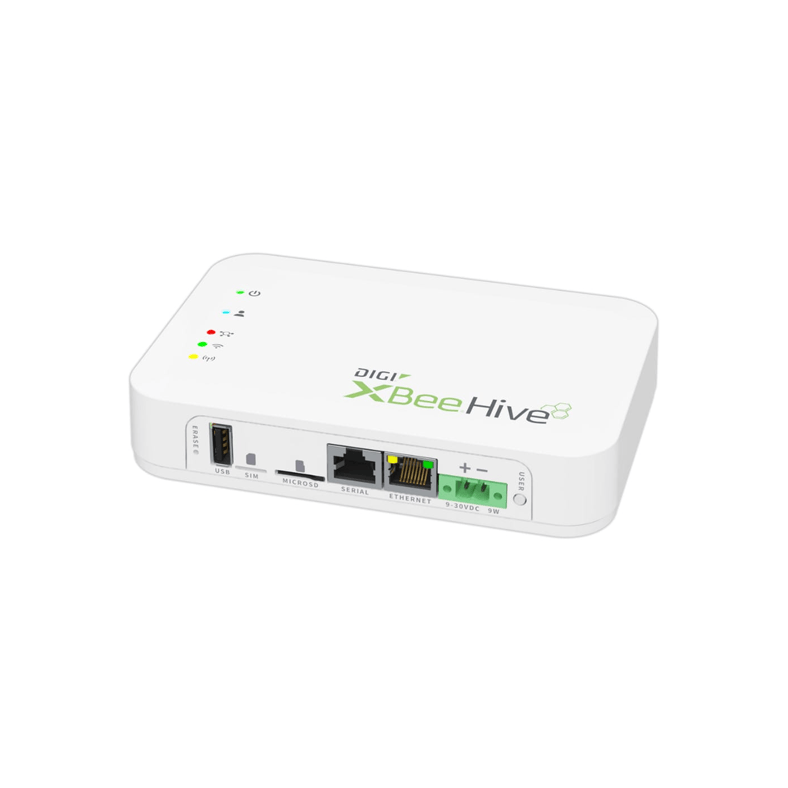
The world-renowned XBee® module is part of a family of RF modules, cellular modems, and long-range solutions for LoRaWAN that provide ultimate flexibility for IoT application developers, with three versatile form factors and a range of popular wireless protocols. The XBee family also includes IoT gateways and management tools to connect, monitor and manage your XBee network.
With Digi XBee, you can develop robust, high-performance connected products faster and more effectively, and get your product to market on your timeline. The complete Digi XBee ecosystem includes modules, code libraries, the award-winning tool suite, Digi XBee Tools, as well as IoT gateways, Digi XBee Studio for configuration and testing, the Digi Mobile App for field management and Digi Remote Manager® to connect, monitor and manage your network. Together, these resources help to simplify and expedite prototyping, coding and range testing to quickly add features such as GPS services and Bluetooth connectivity, build in edge functionality with MicroPython, perform mass firmware updates and more. Pre-certified modules eliminate the pain and expense of certification.



The developer ecosystem that supports your goals
Your time is valuable. You can spend it wisely or reinvent the wheel. Develop your next wireless solution with the robust, secure and versatile Digi XBee ecosystem — a complete collection of modules, tools and resources supporting your product development journey.

Get to market faster with pre-certified solutions
With easy-to-use tools, APIs, and code libraries as well as optional Bluetooth configuration and MicroPython programmability, Digi XBee is easy to develop, deploy, manage, and maintain. Get to market faster with pre-certified solutions and leverage Digi Remote Manager for cloud-based configuration and management.
Field hardened with long haul industrial lifetimes
Field-hardened Digi XBee solutions are built for the long haul with industrial lifespans, harsh environments and mission-critical applications in mind. Digi XBee is trusted by global leaders in every sector, including energy, agriculture, healthcare, smart city, aerospace and Industry 4.0.
Single socket, access to today’s leading protocols
Whether your application demands short or long-range connectivity, public or private networking, point-to-point or mesh topology, multi-regional support or alternate antenna configurations, you can count on the unmatched versatility of Digi XBee. A common platform with global certifications and hardware/software compatibility means that, with a single socket, you have access to todays leading IoT protocols and the assurance of a future-proof design.
Key protections like secure boot, key management
With Digi XBee, security is built-in. Our Digi TrustFence framework gives you the key protections you need, like secure boot, key management, and 175 more controls to protect your applications and devices from new and emerging threats. And since Digi TrustFence designs security into our embedded IoT devices, you’ll be able to adapt to new and evolving threats.
Commercialize from concept to deployment
The number one hurdle for commercialized IoT projects? Scalability. Digi XBee modules can grow with you from initial proof of concept to applications involving hundreds of thousands of connected devices. When you need smart deployment today and growth tomorrow, Digi XBee has you covered.
Ecosystem for supporting tools and resources
With Digi XBee, you have all the supporting tools and resources you need for rapid, successful development. Digi surrounds your solution with a complete ecosystem of software, gateways, certifications, data plans, security, remote management, support and documentation.
Digi International has several 900MHZ wireless technologies ready to go for the NZ market. XBEE, Modem, M2M, Mesh and Long Distance
We are looking for clients who require OEM quantities of these products to make the RF Certification process feasible
MasTec is interested to hear from engineers who have an interest in 900MHZ wireless systems.
You may have noticed that the NZ RF govt.nz group have opened the 900MHZ band to now cover from 915 to 928MHz (with some restrictions).
Contact a MasTec Engineer

A title
Image Box text